







































While I was growing up, the evening news was a TV staple. Local news, sports, and weather filled half an hour. Then there was national news. My mom was a fan of the CBS Evening News with Walter Cronkite; she felt he was very trustworthy. In fact, over the years he somehow acquired the nickname Uncle Walt. What I remember most vividly is his announcement of the assassination of President Kennedy. His struggle to contain his emotions was obvious.
In the late 1950s the U.S. started sending military advisors to Vietnam. By 1964, U.S. destroyers were attacked in the infamous Gulf of Tonkin. President Johnson then decided on the war itself. Once the protests against the Vietnam War became rampant, the government finally found a way to end that ugly war. What helped change President Johnson’s mind was a report by Walter Cronkite. In 1968 the Viet Cong launched the Tet Offensive; it lasted around nine months and killed close to 3000 U.S. soldiers while wounding over 10,000. In February of 1968, Cronkite went to South Vietnam to report on the Tet Offensive; this led to a call for the U.S. to get out of Vietnam. That was when the news outlets began criticizing the war, emphasizing its obvious futility along with the huge loss of life. This resulted in members of the LBJ administration claiming the media was made up of unpatriotic liberals, which infuriated Cronkite: “And it is no breach of patriotism when we [journalists] report on their half of a historic dialogue” (Cronkite’s A Reporter’s Life, 255).
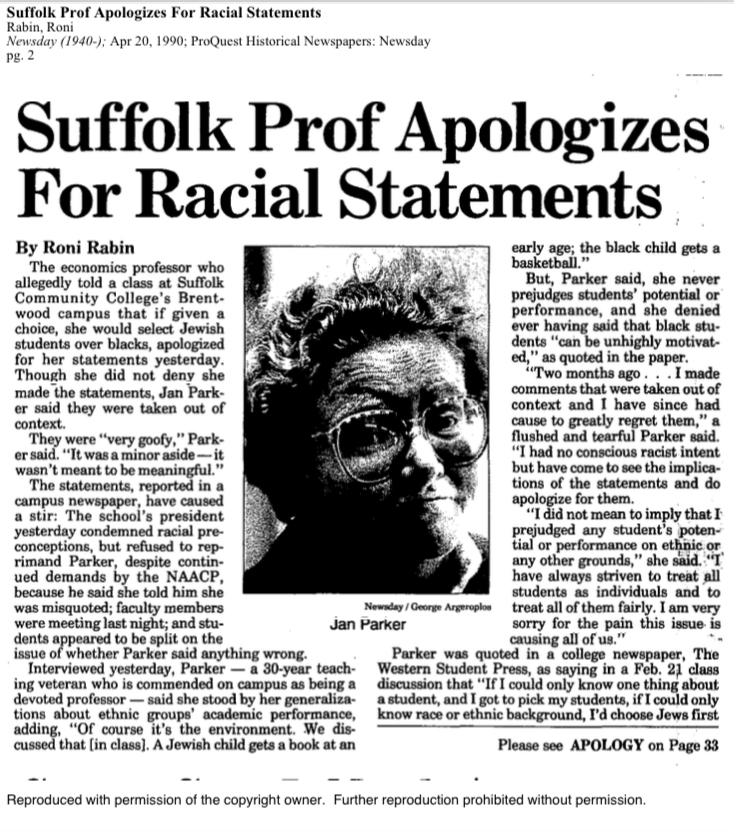
Cronkite’s predecessor on CBS was Edward R. Murrow, who also clashed with the government. Murrow took on Senator Joseph McCarthy, whose persecution and lies – “everybody is a communist!” – led to what quickly became infamous for the destruction they wrought. The House Committee on Un-American Activities harassed people for years until, finally, McCarthy went too far and was shut down. He was especially brutal in his suspicions about how the communists infiltrated Hollywood.
The ugliness of those hearings was clearly demonstrated in an episode of the popular television series M*A*S*H. “Are You Now Margaret” (season 8, episode 2) is about a Congressional aide who is on a fact-finding tour to weed out communists in the army. Since Margaret once dated a boy, Wally, who later became a member of the communist party, she is guilty by association. Actor Robert Vaughn, most famous as Napoleon Solo on the 1960s series The Man From U.N.C.L.E., earned his doctorate degree in Communication from the University of Southern California in 1970. His dissertation, “The Influence of the House Committee on Un-American Activities on the American Theater 1938 – 1958,” is an appraisal of the effect the committee’s activities had on American theater. In 1972, Vaughn released it as a book: Only Victims: A Study of Show Business Blacklisting.
CBS News reporter Edward R. Murrow took on McCarthy in what was at the time rather rare: a live interview. McCarthy was furious and Murrow’s bosses at CBS were none too pleased either. However, Murrow strongly believed that unrestrained political power and corporate timidity were dangerous, requiring journalistic integrity to expose these flaws. Murrow is often referred to as “the man who put a spine in broadcasting.” He’s the one who hired Walter Cronkite in 1950 as a correspondent for the CBS-TV affiliate in Washington D.C. His favorite quote is from Shakespeare’s play Julius Caesar: “The fault, dear Brutus, lies not in our stars, but in ourselves” [I, ii, 140]. Murrow strongly believed in this – taking full responsibility for our behavior.
Another quote Murrow believed in was one made famous during World War II: “Those who cannot learn from history are doomed to repeat it.” Although many attribute the quote to Winston Churchill, it was actually first spoken by George Santayana in 1905.
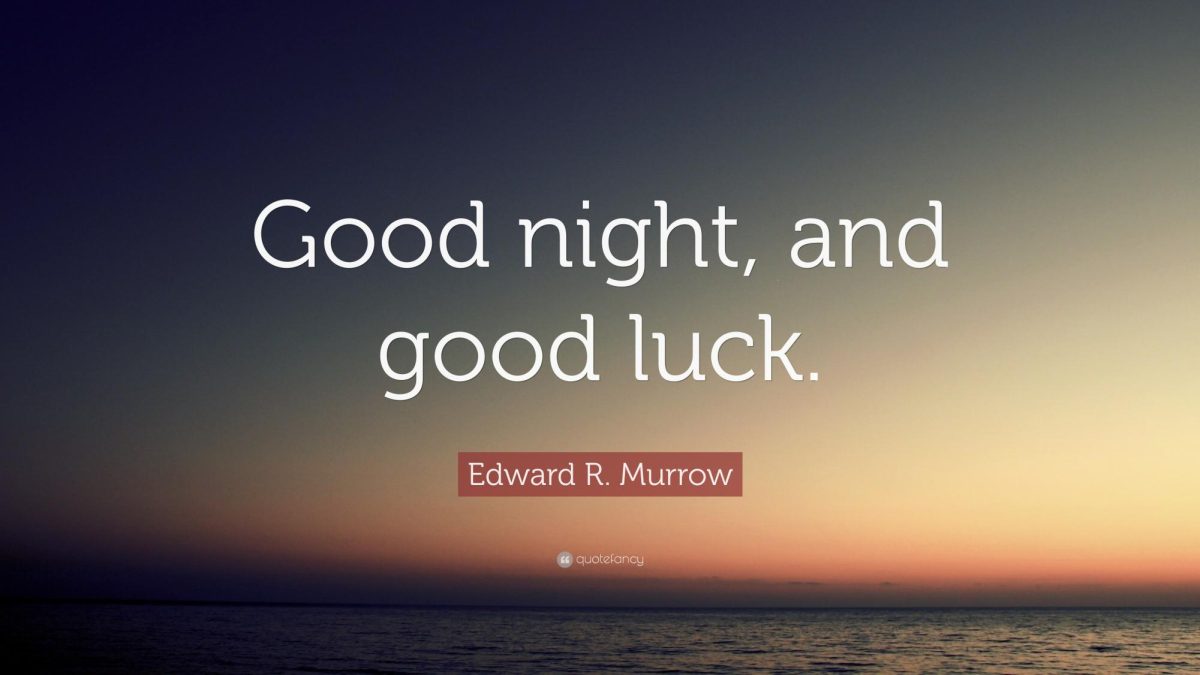
Murrow would end his news broadcasts with “Good night, and good luck” so when George Clooney and Grant Heslov wrote their play about Murrow, that’s what they decided to name it. The show was on stage at the Winter Garden Theater on Broadway until June 2025. Clooney, who played Murrow in the show, decided that all of America needed to see this show. So, he made arrangements with CNN to broadcast a live performance nationally, because he believes it is important that the message about Murrow’s beliefs needs to be spread, and that the broadcast will raise the profile of Broadway.
Unfortunately, as previously mentioned, the show has closed. Although the show is no longer, its themes will never go away. In fact, unrestrained political power, corporate timidity, and journalistic integrity are even more relevant today than they were in 1950. McCarthy destroyed a lot of lives before he was stopped. Let’s stop the current McCarthy before any more damage is done.